Published by Pensions Ireland · · Updated · Editorial standards
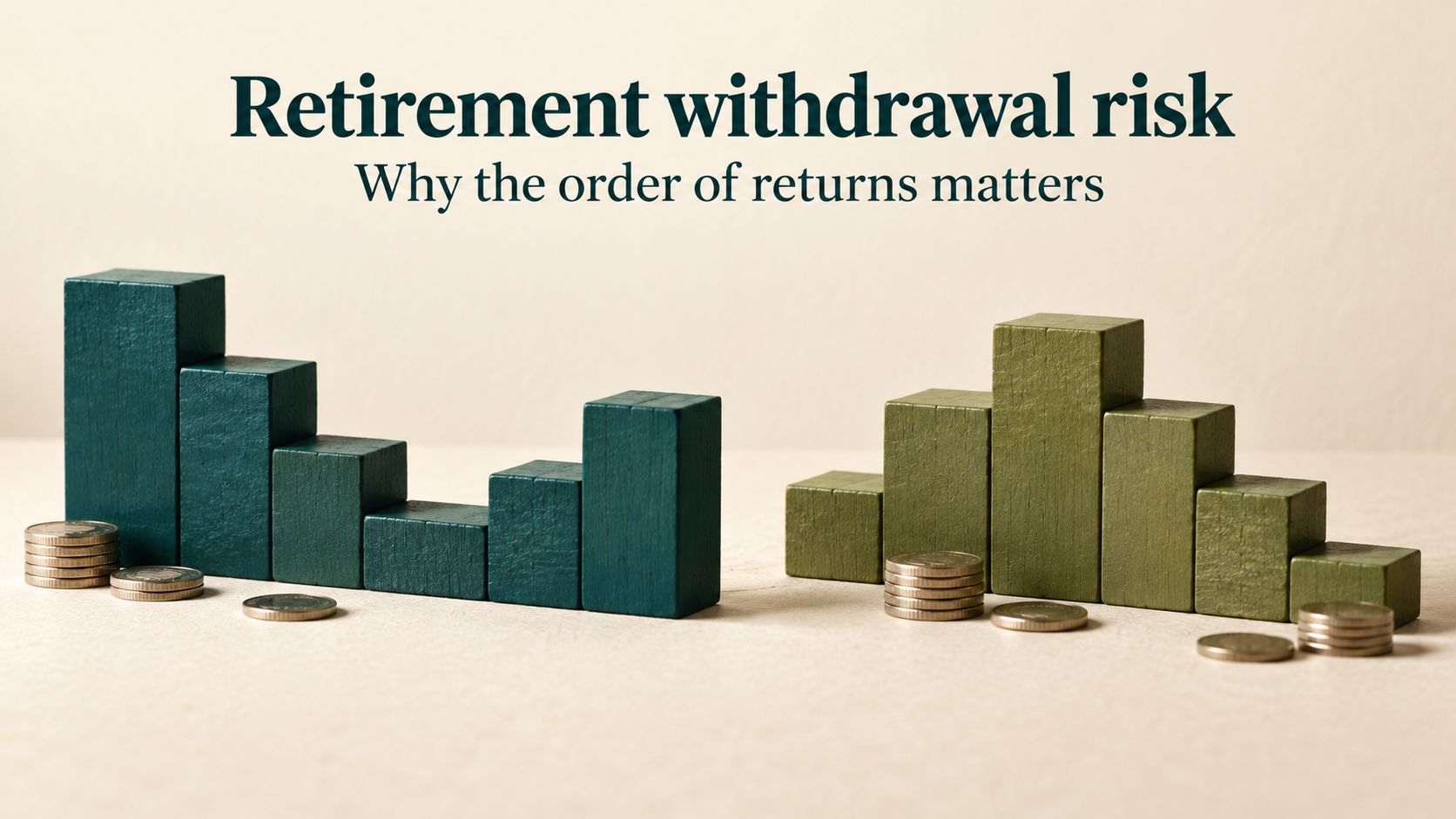
An ARF can provide flexible retirement withdrawals, but it does not guarantee that the money will last. Taking money out during a market fall leaves less invested for a recovery. The order of returns therefore matters, even when two funds experience the same returns overall.
This guide explains retirement withdrawal risk in Ireland for people approaching retirement or reviewing an existing Approved Retirement Fund. It separates three questions: how much you need to spend, how investment losses affect withdrawals, and what Revenue’s deemed-distribution rules do. Those questions interact, but they are not the same calculation. Information checked 16 October 2026.
What changes when you start taking an income?
While money stays invested, its value moves with the investments held. Once withdrawals begin, money is also leaving the fund. A recovery then applies to the smaller amount that remains, rather than to the original balance. This is why a retirement-income plan needs more than a single assumed average growth rate.
An Approved Retirement Fund is a post-retirement investment arrangement, available where the pension rules permit. It keeps investment decisions and withdrawals connected: the amount available for future payments depends on what remains. It is different from buying an annuity, where an insurer provides a regular income under the contract. Neither label alone tells you which option fits your circumstances.
For the wider product comparison, read ARF versus annuity in Ireland. Here the focus is narrower: understanding what a sequence of good and bad investment years can do to a fund that is paying an income.
A worked example: the same returns, in a different order
Imagine two hypothetical funds starting at €300,000. Both pay a fixed gross withdrawal of €15,000 at the beginning of each year. One experiences a 20% loss followed by a 25% gain. The other experiences the same two returns in the reverse order. These deliberately simple returns illustrate the arithmetic; they are not forecasts or a suggested investment strategy.
| Calculation | Loss first | Gain first |
|---|---|---|
| Starting fund | €300,000 | €300,000 |
| After first €15,000 withdrawal | €285,000 | €285,000 |
| After year-one return | €228,000 (−20%) | €356,250 (+25%) |
| After second €15,000 withdrawal | €213,000 | €341,250 |
| After year-two return | €266,250 (+25%) | €273,000 (−20%) |
Each fund has paid out €30,000, but the loss-first fund finishes €6,750 lower. With no withdrawals, both would finish at €300,000 because 0.80 × 1.25 equals 1. The difference arises from the interaction between the returns and the withdrawals, not from giving one fund a better pair of returns.
Look at the second year more closely. In the loss-first case, the €15,000 payment comes out of €228,000. In the gain-first case, it comes out of €356,250. The same cash amount is therefore a larger share of the smaller fund. This is often called sequence-of-returns risk: the timing of losses matters when you are also removing money.
The example excludes fees, tax, inflation, contributions and other cash flows. Gross withdrawals are not the same as spendable income. It is a two-year explanation, not a test of how long a real ARF will last. Changing payment dates, amounts or returns changes the result.
Why a percentage is not a promise of sustainable income
In the example, €15,000 is 5% of the original €300,000. That arithmetic does not establish a safe withdrawal rate. Keeping the same cash payment and keeping the same percentage of the changing fund are different choices. A percentage of a smaller fund produces less cash; a fixed cash payment takes a larger proportion after a fall.
Before comparing illustrations, ask which approach is being used. Does the payment stay fixed, rise with an inflation assumption, or change with the fund? Does the projection show a smooth return every year? A smooth path can be useful for a basic illustration while still failing to show the loss-first problem above. It should not be presented as a guaranteed income path.
Revenue’s imputed distribution is a separate tax rule
The imputed-distribution regime can create a taxable deemed distribution where relevant actual distributions fall short of the specified calculation. It is not a guaranteed investment return or a personal safe-spending recommendation. For an ordinary case within the regime, the relevant assets are valued on 30 November and include the person’s ARFs, vested PRSAs and vested PEPPs.
| Relevant fund value and age condition | Calculation percentage |
|---|---|
| €2 million or less; not aged 70 or over for the whole tax year | 4% |
| €2 million or less; aged 70 or over for the whole tax year | 5% |
| More than €2 million | 6% |
The regime applies where the holder is aged 60 or over for the whole tax year. Turning 70 during a year does not meet the whole-year 70 condition. Relevant actual distributions reduce the specified amount, with no negative deemed amount. Ask the qualifying fund manager to confirm the calculation across all relevant arrangements.
For example, assuming the 4% condition applies, a €300,000 relevant value gives €12,000 before allowing for actual distributions. If €8,000 of relevant distributions count, the remaining deemed amount is €4,000. That €4,000 is an amount treated as distributed, not the tax bill itself. Tax treatment and the net cash received require a separate calculation.
Build the spending plan before choosing the withdrawal figure
Start with expected household spending and separate regular essentials from spending that could change. Then compare it with the income you expect to receive, recording when each source starts. A gap before another pension begins is a timing question as well as an annual-budget question. A one-year average can hide that gap.
Our retirement planning guide helps organise that comparison. Do not assume a State Pension entitlement, start date or amount without checking your position. Keep confirmed income separate from an estimate. Also separate a gross ARF payment from the money available after deductions: a €15,000 withdrawal is not automatically €15,000 to spend.
Review risk, charges and flexibility together
A useful review asks what happens if the fund falls before the next planned payment. Which spending is essential? What other income would still arrive? Could the payment change, and what would that mean for the household? These are planning questions, not instructions to stop withdrawals or switch funds after a fall.
Check the actual contract’s investment and service charges rather than assuming a universal annual fee. Record who receives each charge, whether it is fixed or percentage-based, and what service is included. Charges reduce the amount retained in the arrangement. The pension charges guide explains the questions to compare.
Inflation and a longer retirement add separate pressures. Money set aside for later years still needs to meet later costs. Read the inflation and retirement income explanation alongside this example; do not treat an unchanged cash amount as an unchanged standard of living.
What this explanation cannot decide
No single return sequence, percentage or calculator determines a suitable ARF strategy. Personal tax, other assets, health, dependants, scheme benefits, contract terms and the ability to absorb a loss can change the decision. The examples do not choose an investment mix, recommend a cash reserve or establish an individual withdrawal amount. A qualified advisor can test scenarios and explain alternatives within the scope of their service.
Frequently asked questions
Does an ARF guarantee an income for life?
No. An ARF is an investment arrangement. Payments and investment outcomes affect the remaining fund; the label does not guarantee that it will last for life.
Is Revenue’s 4% calculation a safe withdrawal rate?
No. The imputed-distribution calculation is a tax rule. It does not establish a sustainable personal spending level or guarantee a return.
Can two funds with the same returns finish differently?
Yes, when withdrawals interact with those returns. The worked example shows different closing balances when the same two returns occur in a different order.
Does the retirement calculator model a market crash?
The linked calculator uses its stated planning assumptions. A smooth growth illustration is not a sequence-of-returns stress test and cannot select a suitable ARF withdrawal.
Resources: explore the numbers after the explanation
The worksheet helps record spending, income dates and a loss-first review question. The calculator provides a separate planning illustration; it does not model the two-year sequence above or an individual ARF tax liability.